

Watch
Agents read the inbox and messages, and patrols check hosting, domains, security and account balances across every site we run.
Dembe OS
Dembe OS is the operating layer behind Champlin Enterprises. AI agents watch the inbox and the servers, turn what they find into tracked work, ask before anything changes, and deliver every change as a tested GitHub pull request.
We built it for ourselves first, and it runs our business every day. Below is the console we watch it from.
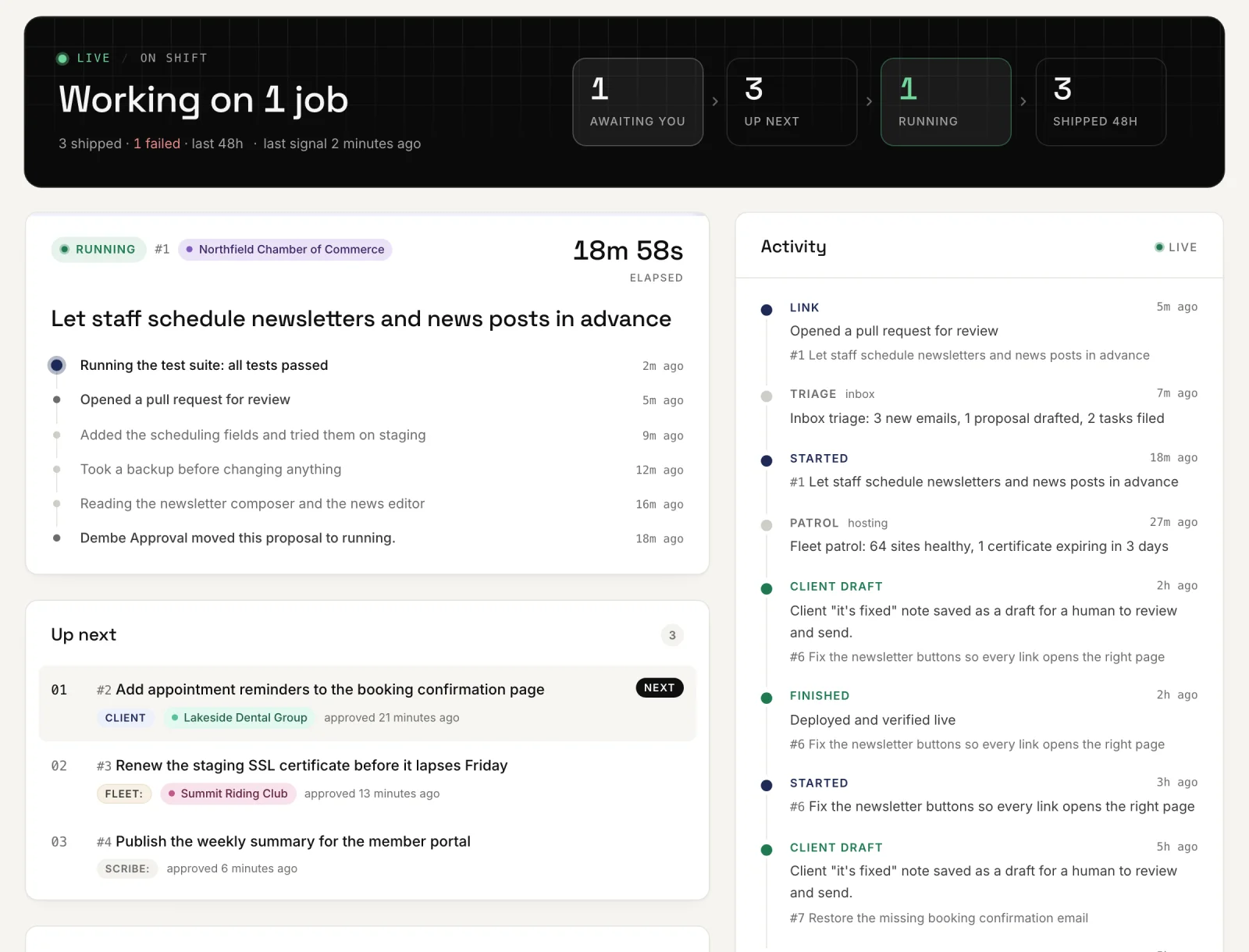
Agent Ops Live
What is waiting on a human, what is queued, what is running right now and what went live, updating live. This is the real console, shown with sample data.
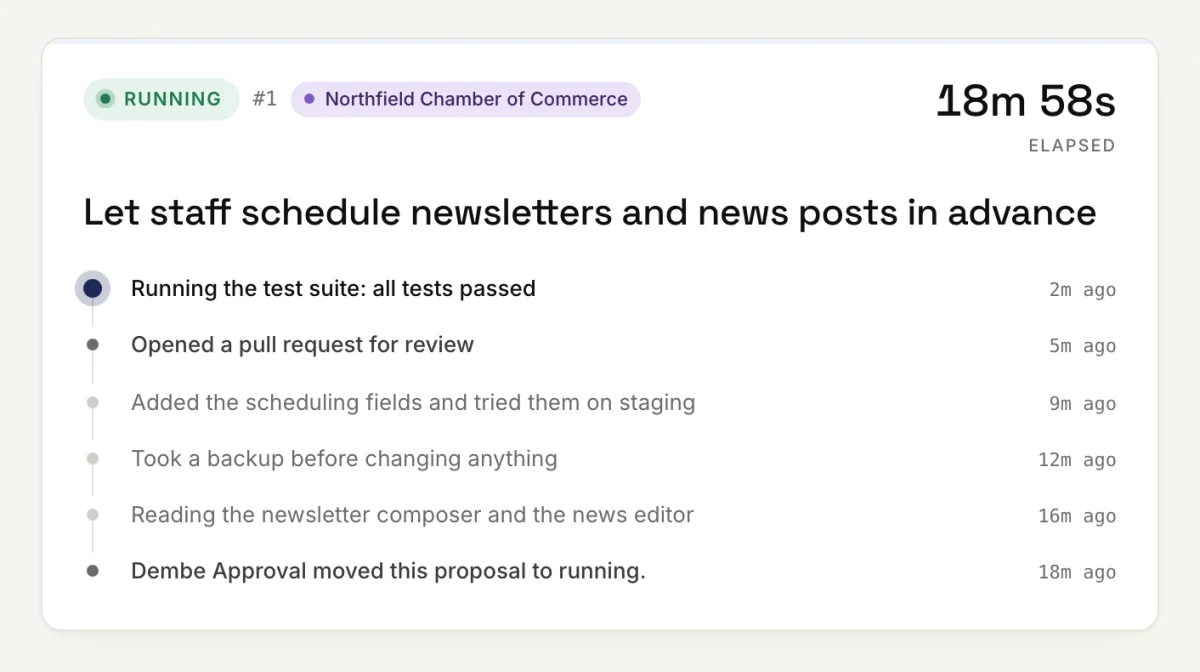
Watch it work
The running job reports each step as it happens: what it read, the backup it took, what it changed, the tests it ran. You never have to wonder what an agent is doing, or whether it is still doing anything at all.
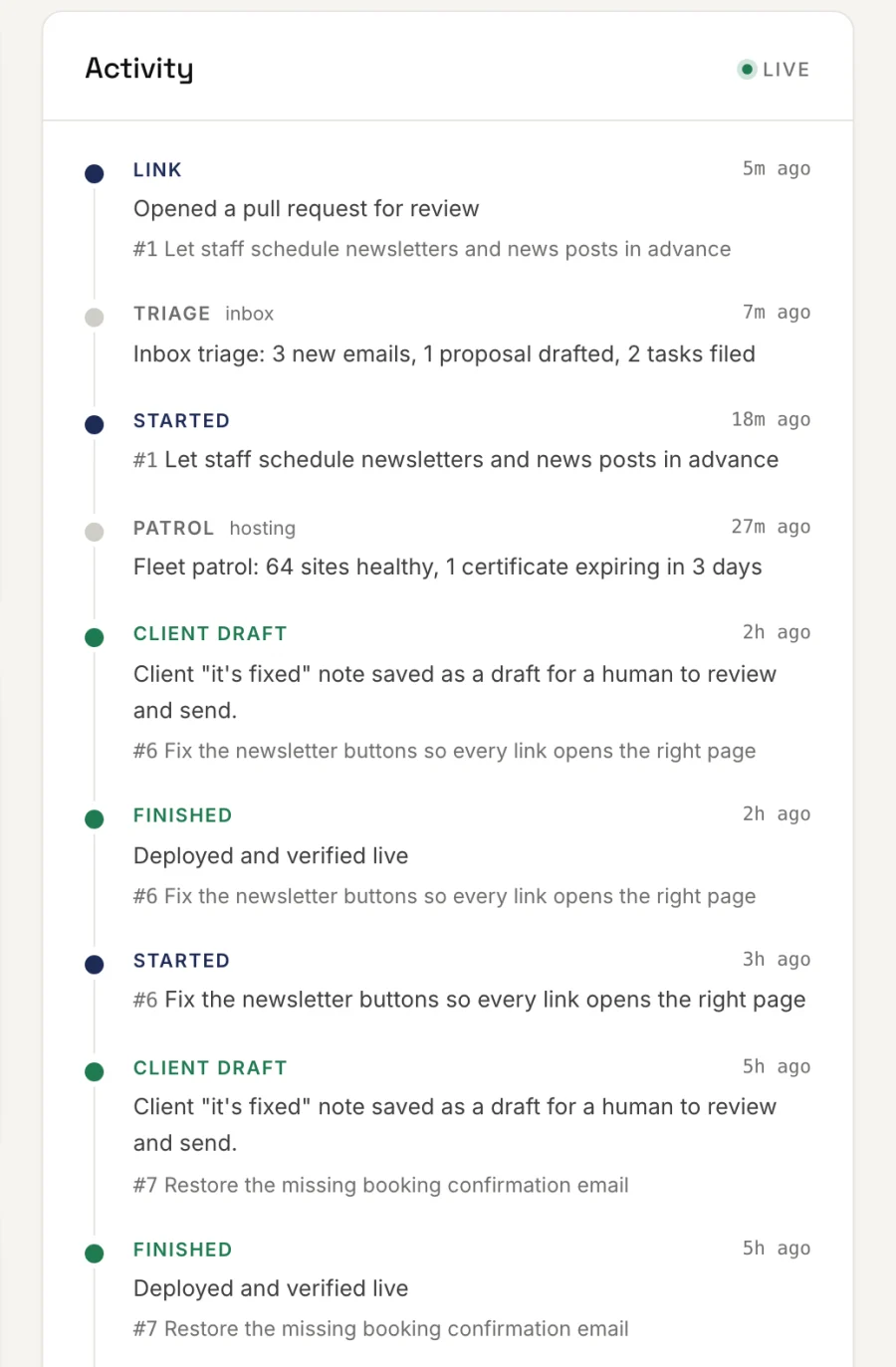
Nothing off the record
Inbox triage, fleet patrols, approvals, deploys and the client drafts waiting for review all land in one live stream. It is the same record the invoice is built from, so every hour has a trail behind it.
How it works
Agents read the inbox and messages, and patrols check hosting, domains, security and account balances across every site we run.
A client request or a problem a patrol finds becomes a tracked task, filed against the right client, in plain words.
Anything that changes something real becomes a proposal: the issue, the evidence, the fix, the risk and the estimated hours.
A human reads it and clicks Approve or Reject. Nothing risky runs on its own, and nothing is emailed to a client unread.
An agent does the approved work on its own branch, writes and runs the tests, opens a pull request on GitHub, and goes live only after the required checks pass and the change is merged. Then it books the time with a breakdown.
How it goes live
Plenty of AI tools write code. Dembe OS delivers it the way a disciplined engineering team does: every change is a GitHub pull request with tests, required checks and a guarded deploy. Nothing reaches production any other way.
Every change starts on a fresh branch, isolated from live code and from any other agent working at the same time.
The agent writes tests for what it changed and runs the full suite. A red suite stops the job before anything else happens.
The change opens as a pull request with a plain summary of what changed and why, so every line has a reviewable history.
Automated checks must pass before GitHub allows a merge. The main branch rejects direct pushes outright, including ours.
Deploy scripts refuse anything that is not exactly the merged code. Data changes get a backup first.
The agent checks the live site after the deploy and reports what it saw. Only then is the job marked live.
Add appointment reminders to the booking confirmation page
feature/appointment-reminders main
4 files changed +212 −18
Guardrails
Agents that can act are only useful if you can trust what they will not do. These rules are enforced in code, not left to good intentions.
Agents investigate freely. They change nothing that matters until a person has read the proposal and said yes.
Client email is always written as a draft for a human to review. There is no path in the system that emails a person on its own, and a standing self-check raises the alarm if one ever appears.
A single off switch halts every agent at once. Autonomy you cannot turn off is not a feature.
The quiet failure is the dangerous one: a feed that stops while every log still looks fine. Self-checks alert once when something goes wrong, not a hundred times.
Who proposed it, who approved it, what ran and when. The audit log is the record, not anyone’s memory.
Every change is a GitHub pull request with tests and required checks. The main branch rejects direct pushes, even ours, and deploys refuse anything that is not merged. No shortcuts to production.
For our clients
You never log into Dembe OS. You just notice that nothing slips, problems get fixed before they reach you, and every hour on your invoice has a reason behind it.
An emailed ask becomes a tracked task within half an hour, even when it is buried in the fourth paragraph of a long thread.
Patrols catch expiring domains, exposed files and dry service balances while they are still small.
Every invoice line is an outcome in plain English, backed by an internal breakdown of where the hours went.
Kevin Champlin, our principal engineer, leads Dembe, our AI engineering lead, and a disciplined set of named AI agents (Ari, Mason, Avery, Piper, Tess, Vera, Knox, Ada, Quinn, Iris, Ripley). Together they cover work that used to need a department, without handing judgment to a machine.
Questions
Dembe OS is the operating layer Champlin Enterprises runs on. It connects AI agents to our inbox, our servers and our work tracking, so client requests and infrastructure problems become tracked tasks and approved work instead of things someone has to remember.
They investigate and prepare on their own. Anything that changes a system, touches payments or reaches a client waits for a human to approve it, and client email is always a draft for review.
Production-grade. Every change an agent makes goes to GitHub as a pull request, with tests and required automated checks that must pass before it can merge. The main branch rejects direct pushes, deploys only release merged code, and data changes are backed up first. It is the same engineering process a disciplined team follows, and it runs our business every day.
Dembe OS is built on Anthropic’s Claude models, with the model chosen per task: the most capable model for planning and hard problems, faster and cheaper models for routine work.
Yes. The same pattern (watch, notice, propose, approve, do, record) fits any business that runs on email and recurring operational work. We build it on top of the tools you already use. Let’s talk about what yours would watch.
We engineer AI agents that work inside your real systems, with the approvals, audit trail and off switch built in from day one.