
I have a confession: I love a good Post-it. There is something satisfying about catching a thought, writing it on a little square of paper, and slapping it somewhere I will actually see it. What I do not love is what my desk looks like an hour later — a fringe of curling notes around my monitor, half of them outdated, none of them where I need them.
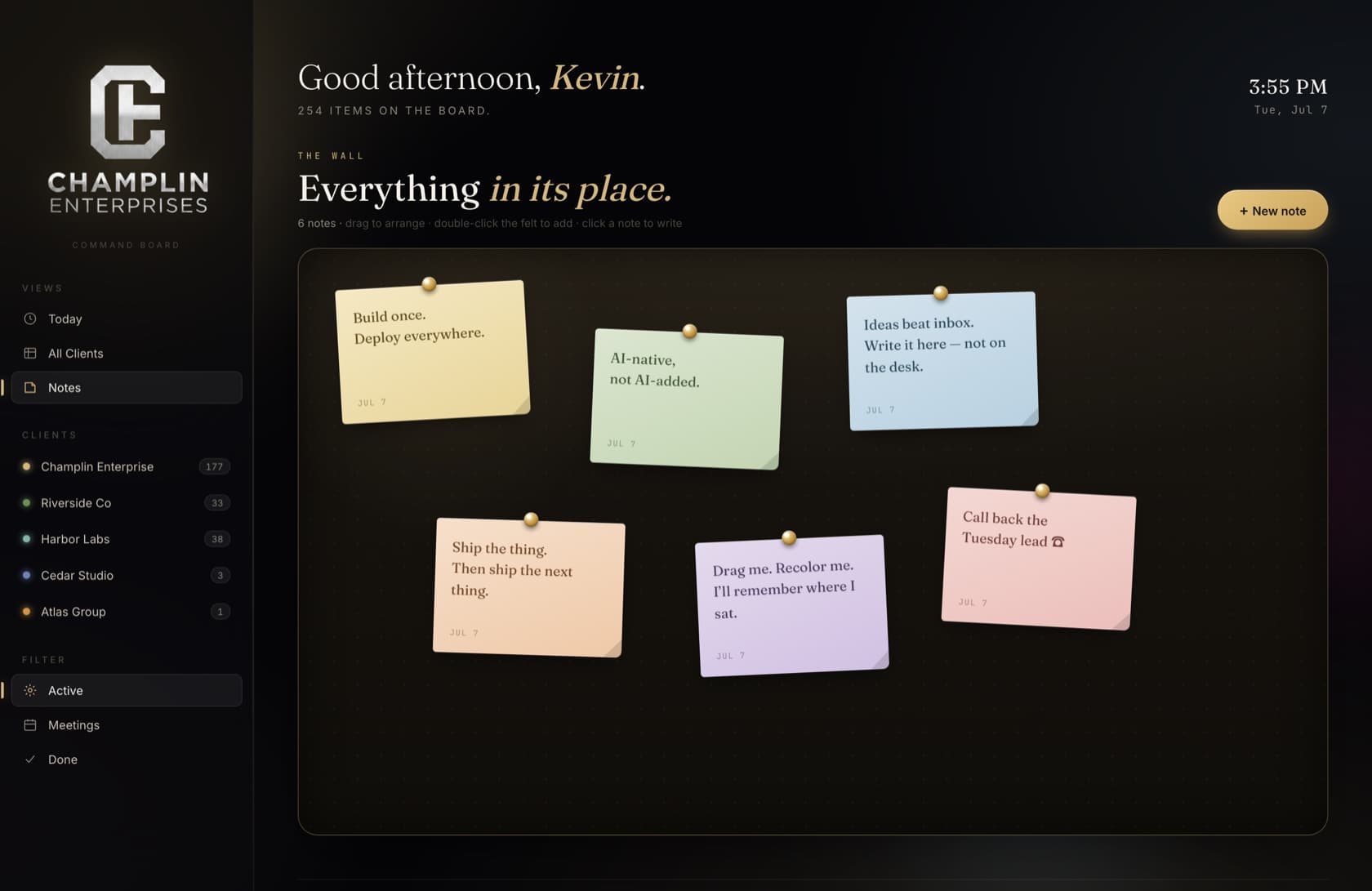
So I did what I always do when a small thing annoys me enough: I engineered it away. I built a sticky-note wall into my Command Board — the private dashboard I run the whole operation from — and I let myself go completely overboard on the details. It is called The Wall, and it is the most fun I have had building something in a while.
Here is the thing about a feature like this: it looks trivial. It is sticky notes. You write on them, you move them around, you throw them away. Anyone can wire up “draggable colored boxes” in an afternoon. But the gap between functional and something you actually want to touch is a hundred tiny decisions — and that gap is the whole game.
Let me pull back the curtain.
It had to feel like paper, not a rectangle
A cheap sticky note is a yellow box with a drop shadow. Mine are paper. Each note is a warm gradient with a faint layer of grain baked in, so it catches light like fiber instead of glass. The bottom-right corner has a real dog-ear that peels open a little further when you hover. The shadow is not a flat gray blur — it is warm-tinted and layered, the way paper actually sits above a surface. And every note is held by a brushed-brass pushpin with a tiny glint, pulled straight from the metal in our logo.
None of that is necessary. All of it is why it feels good.

One gesture, two meanings — the five-pixel trick
This is my favorite detail, and you will never notice it, which is exactly the point. On a sticky note you want to do two things: move it and write on it. Most apps make you choose — a drag handle over here, an edit button over there. That is just clutter of a different kind.
The Wall watches your pointer instead. Press and move more than five pixels and it is a drag: the note straightens, scales up, its shadow blooms, and it follows your cursor. Press and do not move, and it is a click: the cursor drops into the text and you just start typing. Same gesture, read by intent. No modes, no handles, nothing to hunt for. It runs on raw pointer events, so it behaves identically under a mouse, a trackpad, or a thumb.
Physics you can feel
Nothing on The Wall moves in a straight line, because nothing in the real world does. Pick a note up and it springs, with a little overshoot as it levels out. Drop it and it settles with a subtle bounce before relaxing back to its resting tilt. New notes do not simply appear; they drop in and pop. When the board loads, the notes cascade in one after another. Delete one and it peels off the board and flies away instead of blinking out of existence.
Underneath, these are just carefully tuned easing curves — a handful of cubic-beziers with a bit of overshoot. But they are the entire difference between “a thing happened” and “that felt right.”
It remembers, instantly, with no save button
Every note’s position, color, rotation, and text is saved the moment you change it — no Save button, no spinner, no server round-trip. Nudge a note a centimeter and that centimeter is remembered. Recolor it and the color stays. Come back tomorrow and the wall is exactly how you left it. It is stored right in the browser, so it is instant and it is private. This is my scratch space, and it behaves like one.
So why sweat all of this?
Because this is the entire philosophy in miniature. The difference between software people tolerate and software people love is almost never the feature list. It is the hundred small decisions underneath it that nobody can point to but everybody can feel — the peel of a corner, the weight of a pin, the gesture that reads your intent instead of making you announce it.
Being AI-native is what buys me the room to care about that. The plumbing that used to eat a week now takes an afternoon — and the afternoon I would have spent on plumbing goes into the grain of the paper and the bounce of the drop instead. That is not decoration. That is the product.
My desk is finally clear. And every idea I used to lose to a curling square now lives on a little brass-pinned wall that remembers exactly where I put it.
— Kevin