
On a Friday evening, a letter from the U.S. government landed on Anthropic’s desk, and three days after launch, Claude Fable 5 — the most capable model the company had ever shipped — went dark for every user on the planet. An export-control directive cited national security; access to Fable 5 and Mythos 5 was suspended worldwide, mid-project, overnight.
Most of the commentary has been about AI safety, geopolitics, and export law. That’s the wrong conversation for engineering leaders. The actionable lesson here has nothing to do with policy and everything to do with architecture: your AI model layer is a critical, externally-controlled dependency — and most teams have wired it in like a permanent utility.
You bought a dependency. You architected a utility.
Electricity is a utility. It is fungible, commoditized, and contractually obligated to keep flowing. A frontier AI model is none of those things. It is a single-sourced dependency, controlled by one vendor, subject to that vendor’s pricing, capacity, terms of service, model-deprecation schedule — and, as of last week, the directives of a government.
We’ve watched teams make the same category mistake repeatedly: a flagship feature gets built around one provider’s newest model, calling that provider’s SDK directly, tuned to that specific model’s quirks, with no abstraction in between and no answer to the question “what happens when this endpoint returns 404 forever?” In a demo, it’s magic. In production, it’s an unhedged bet that a dependency you don’t control will behave like a utility you can take for granted.
Fable 5 didn’t get more expensive or slower. It ceased to exist as an option. The teams that felt nothing were the ones who had already designed for it. The teams scrambling on Saturday morning had confused “the best model available” with “a stable part of our system.”
What dependency-aware AI architecture actually looks like
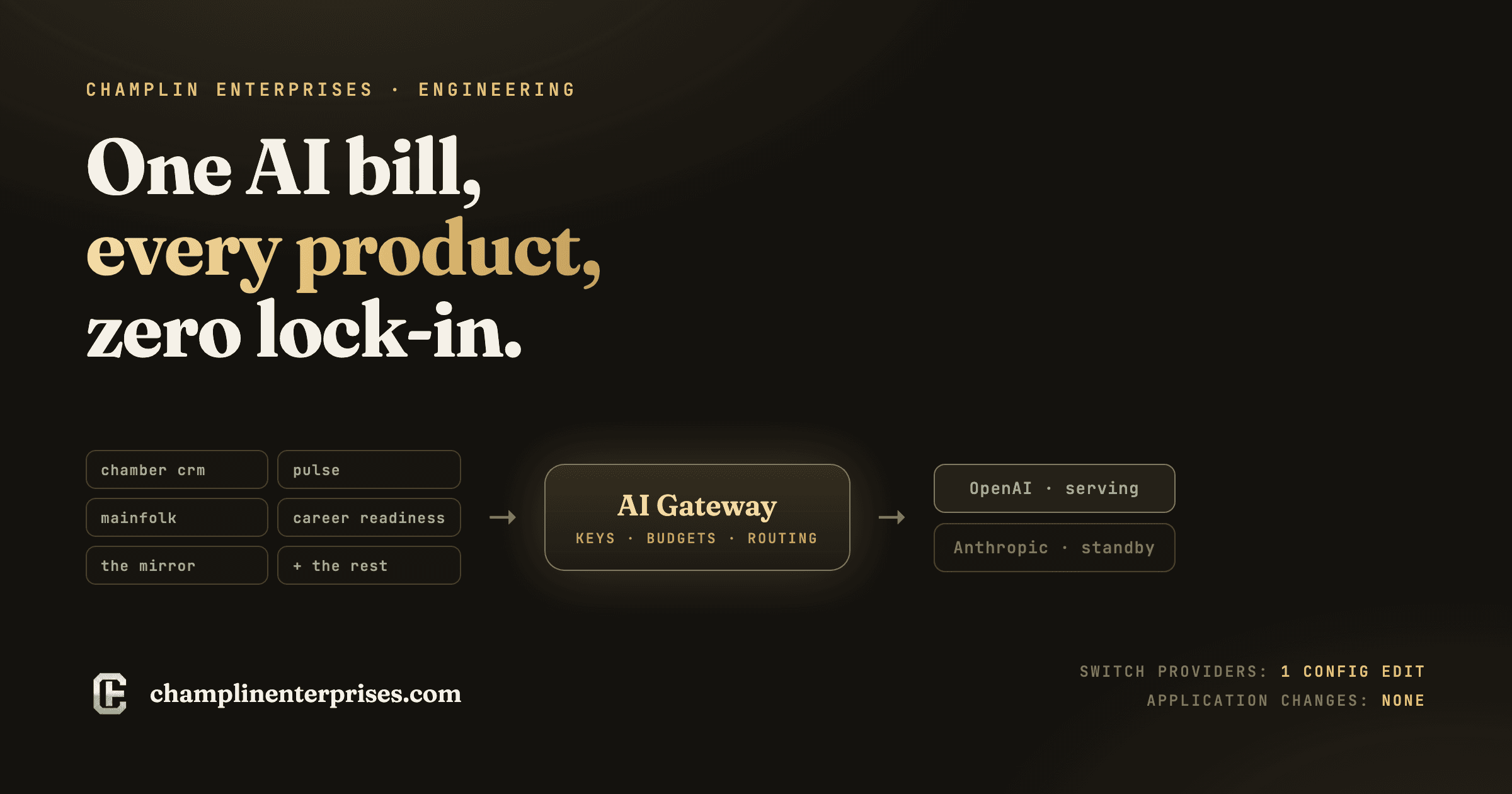
Treating the model layer as the volatile dependency it is doesn’t mean using worse models. It means building so that the choice of model is a configuration decision, not a foundational one.
- Put an abstraction between you and the vendor. Your application should talk to a model interface, not to one provider’s SDK scattered across forty files. When the interface is clean, swapping the model behind it is a config change and a round of evals — not a rewrite.
- Design for graceful degradation, not just happy-path excellence. A primary model, a fallback from a second vendor, and a smaller model you control should sit behind the same call. If the flagship vanishes, the feature gets quieter — it doesn’t fall over.
- Hold evals as your portability insurance. The reason teams feel locked to one model is that they can’t prove a replacement is good enough. A real evaluation set — ground-truth cases, an automated judge, regression tracking — turns “we can’t risk switching” into “we switched on Saturday and the scores held.”
- Know your data-residency tier per workload. Not every task belongs in someone else’s data center. Sensitive, regulated, or air-gapped workloads (health, legal, finance, defense) are exactly where open-weight models running on infrastructure you control earn their keep — not because they’re smarter, but because they can’t be revoked, rate-limited, or subpoenaed out from under you.
- Audit your capability-concentration risk. If a single, externally-controlled model is the only thing standing between you and a broken product, that’s not an AI decision — it’s a business-continuity gap. Name it in your risk register the way you’d name a sole-supplier component.
The uncomfortable trade nobody wants to price
Here’s the honest tension: the frontier models really are better, and chasing the best one is rational. We do it too. The mistake isn’t using a powerful cloud model — it’s using it as if it were load-bearing infrastructure when it’s actually a rented capability with a cancel-anytime clause held by someone else.
The fix is to price that risk on purpose. For each AI-dependent feature, ask three questions: If this exact model disappeared on Friday, what breaks? How fast could we be running on something else? Which of these workloads should never have left our own walls in the first place? Most teams have never asked. The ones who had, shipped through last week without a war room.
This is what “AI-native” is supposed to mean
AI-native isn’t using the newest model. It’s building systems where AI is a first-class, well-governed dependency — abstracted, evaluated, portable, and matched to the right execution environment for the data it touches. AI-added is wiring a single vendor’s endpoint into your critical path and calling it a strategy.
The Fable 5 ban will fade from the news cycle in a week. The architectural question it exposed won’t: can your product survive the disappearance of the model it’s built on? If you’re not sure of the answer, that’s the work — and it’s the kind of work we do. If you’re building AI into something that matters and you want it engineered to outlast any one vendor’s bad Friday, let’s talk.